
Theta is more than a convenienent mnemonic technique for "think tank".
In uppercase, Θ as shown in the banner, theta denotes the decay in the value of an option as time passes. An option to call stock at a strike price of 50 is "in the money" at time T if the stock is traded for a higher price at that time; or "out of the money" if the stock is then traded for a lower price, say 40. Even an "out of the money" option is worth something, because the probability of a rebound of the stock price prior to the expiry of the option period is not zero. As the date of expiry approaches, that possibility diminishes, or "decays".
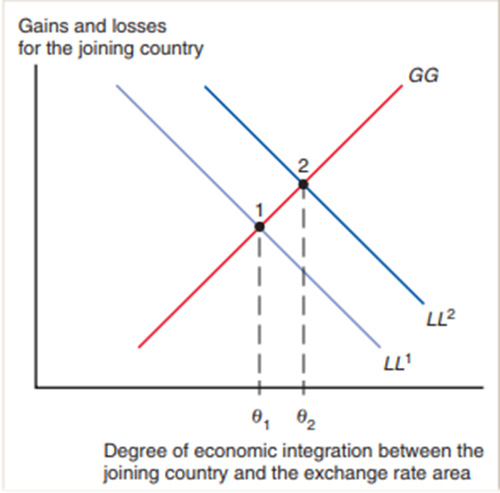 |
In lowercase, θ is used by Nobel Prize laureate [2008] Paul Krugman to denote the minimum degree of economic integration (trade and factor mobility) required to consider the possibility of joining a single currency area such as the Euro, or peg one's own national currency to that of another country or monetary area. When the size and frequency of market perturbations are greater in any specific candidate country, the curve of potential losses from integration shifts upwards and to the right, here from LL1 to LL2, pulling the θ minimum in the same directions. With higher probable losses from pegging the currency of a rather volatile country to that of a less volatile country or group, the finishing line (currency board or single currency) θ is at a point in which there is greater freedom of trade, and greater mobility for capital, labor and whatever other factors are in the production equation. This being said about the equation by the opt-in finishing line, the question remains the desirable value of θ on the starting blocks, when enforceable Law (from European treaties to domestic legislation like the Argentine convertibility Act [1991], and below for Central Bank circulars) stacks up binding content behind wishful thinking. In 2004, the Inter-American Development Bank's Institute for the Integration of Latin America (INTAL) awarded a special mention to research on this dimension of θ. This research started from the fact that monetary cooperation is driven by Law rather than equations, self-evident if it wasn't supported by empirical evidence, too. The conclusion that there must be some trade-off between the optimal and the legally enforceable values of θ hardly qualified as ground-breaking. What, then, could have earned this research an award? Maybe the idea that what Krugman presents as prerequisites of successful opt-in could actually be, to a certain extent, its beneficial outcomes (for instance, higher volumes of trade and greater factor mobility). Or maybe a consequence of that idea: much like there are prerequisites, gains and losses from opt-in, there should be prerequisites, gains and losses for opt-out (a point on which the Law driving the process remains silent). |
| Also in lowercase, θ appears in a production equation derived by Nobel Prize laureate Finn Kydland [2004] from the Neoclassical growth accounting model, for any given time period t, denoting the share of capital input in national income, where Y is the aggregate outpu and A is the total factor productivity (TFP): Yt = A Ktθ Lt(1-θ) Kydland remains the sole Nobel laureate who explicitly referred to the G20 president for 2018, Argentina, in his acceptance lecture (video on the left, at about 34minutes). Calibrated with averages (lacking day-to-day figures for national income, and for the substitution rate between K and L intensities during capital flight episodes), the equation is consistent with the depression of the nineteen eighties; but would predict, for the subsequent rebound of the nineties, an investment much stronger than the one which actually happened. Research on the Legal and Tax Framework of International Payments of Latin-American Countries completed in 1984, again commissioned by the Inter-American Development Bank's Institute for the Integration of Latin America (INTAL), showed that regardless of regulations, countries will not pay much dividend, royalty or interest during long periods of low or declining productivity -simply because capital, technology and loans have best been diverted elsewhere. Since, a growing body of literature suggests that small open economies face payment bottlenecks during expansion, not downturn as intuition might suggest. Converserly, during periods of high productivity growth, the Neoclassical model predicts a lot of investment. Relative to this model, there is an anomaly when productivity gains soar to 7% a year but GDP per working adult grows at just 4%, suggesting decline, rather than growth, in capital intensity. One possible explanation is that the investors populating this model have no recollection of past defaults, while real-life investors do. Another is that real-life investors "read" the business cycle differently, and gather that a country's incentives to renege on payments are highest when it has plenty of capital. There could be several others. Whether or not the model of a small open economy incorporating the possibility of default can resolve the shallow capital anomaly remains, Kydland says, a challenging open question that should stimulate much needed and exciting research effort. |